
Defensive high‑speed driving course in Milan.
Professional course for security drivers: vehicle dynamics, evasive J‑Turn maneuvers, controlled ramming and convoy driving. ISO 9001:2015 standard. Since 2017.
The corridor open.
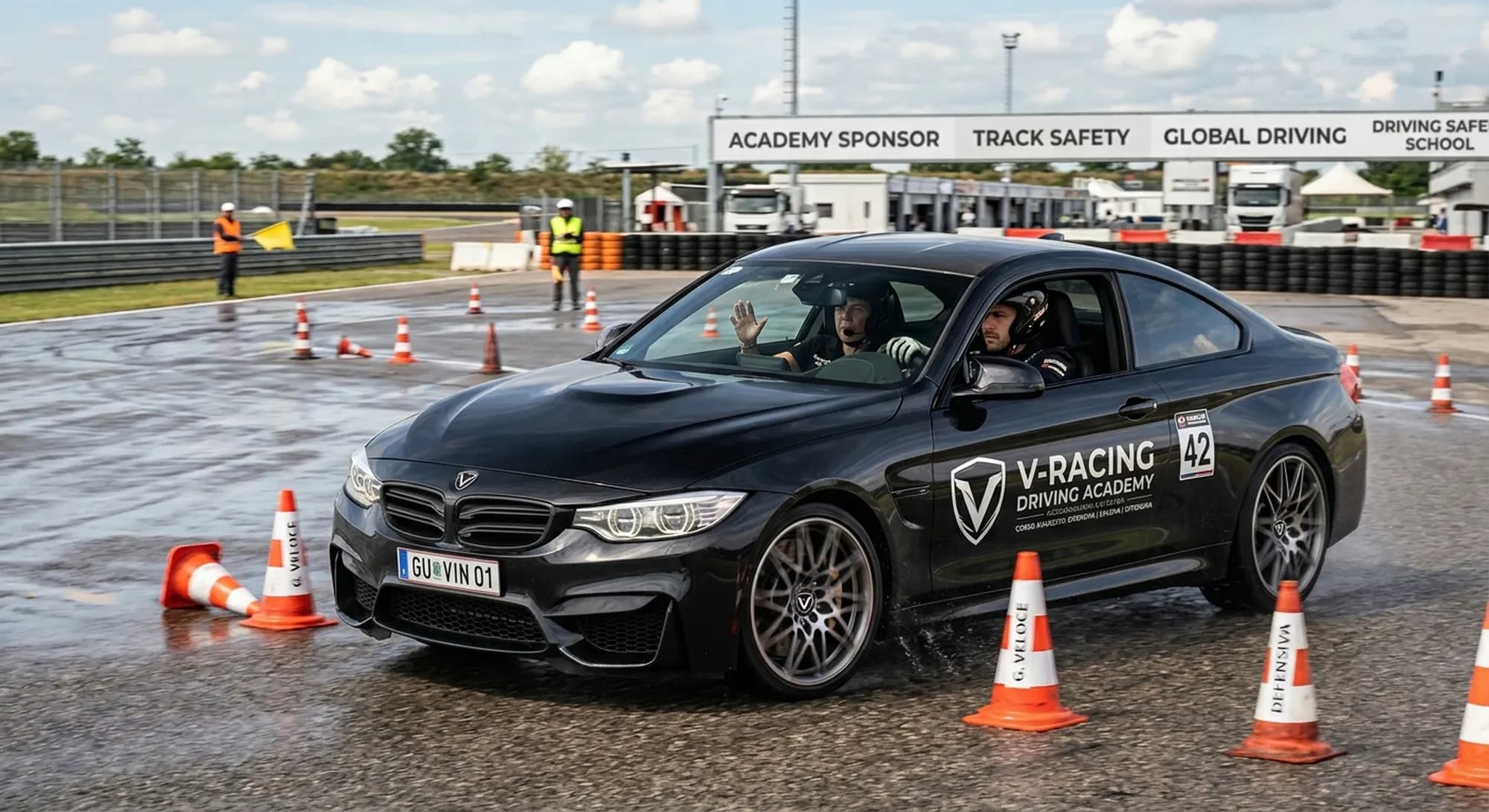
In the context of close protection for VIPs, Key‑Men and institutional personalities, the motor vehicle is the most exposed link to potential exogenous threats. Arcadia Company's fast, defensive and evasive driving course is designed to impart professional drivers, sworn guards and security operators with the technical skills required to control the vehicle under extreme dynamic conditions. The training is not aimed at sporting or motorsport purposes, but is strictly focused on crew safety, load‑transfer management and the execution of rapid disengagement maneuvers from ambush or area‑saturation scenarios (choke points). For this area see our Close protection and event management.
The training programmes are delivered in compliance with the quality standards of the ISO 9001:2015 certification and take place on approved racetracks and protected circuits. The theory‑practice sessions examine the physical limits of mechanical traction and defensive driving and counter‑surveillance protocols, providing corporate management with a professional training pathway of the highest technical content and full legal compliance. See our authorisations and certifications for the credentials behind this work.
Structure of the training course and mechanical skills
The curriculum is organized into sequential modules ranging from the study of physical forces acting on tires to the execution of complex evasive maneuvers in confined spaces:
| Operational module | Technical and instrumental skills | Tactical application and security |
|---|---|---|
| Physics and dynamic control | Management of load transfers, progressive braking, analysis of the Kamm circle and control of understeer/oversteer. | Optimization of grip and maintenance of the safety trajectory before activation of electronic systems (ESP). |
| Advanced evasive maneuvers | Execution of rapid reversals (J‑Turn, Y‑Turn) and controlled kinetic ramming techniques. | Immediate disengagement and overcoming of roadblocks or artificial fixed barriers. |
| Defensive driving and accompaniment | Application of the space rule, peripheral vision, convoy trajectory planning and counter‑surveillance. | Early interception of tailing activity and mitigation of horizontal collision risk. |
Vehicle physics and dynamic control engineering
The fundamental basis of every advanced security maneuver lies in the analytical management of horizontal and vertical load transfers. Any input applied by the driver to the steering, braking or acceleration systems shifts the vehicle’s centre of gravity, instantly altering the tire contact patch. The course trains participants on handling the Kamm circle, the mathematical model that defines the molecular grip limit of a tire when subjected to the simultaneous combination of lateral (centrifugal) and longitudinal (acceleration/braking) forces.
During on‑track practical sessions, trainees acquire the technique of progressive braking, which involves applying maximum initial hydraulic pressure to the brake pedal, followed by a gradual, controlled release synchronized with steering‑angle variation. This protocol ensures the front axle retains directional stability, preventing wheel lock‑up. The course also delves into correction methods and intentional use of understeer and oversteer phenomena on low‑friction road surfaces, training the operator to sense the chassis’s structural reactions through the seat and steering wheel (kinesthetic sensitivity), anticipating the response times of auxiliary electronic systems (ABS, ESP) that in extreme operational contexts could limit vehicle mobility.
Tactical evasive techniques: J‑Turn and ramming clearance protocols
The specialist core of the course focuses on evasive maneuvers required to force or evade an interception attempt or geographic blockage of the escape route. Drivers are trained in the technical execution of the J‑Turn (rapid reverse‑direction turn), a kinetic maneuver that enables a 180‑degree change of travel direction in confined spaces: by exploiting reverse speed, the driver induces a sudden load transfer to the front axle through a controlled steering input, then stabilizes the vehicle in the new direction of travel without interruption and eliminates stationary dead time.
The use of the Y‑Turn (three‑phase high‑speed tactical reversal) and the engineering study of controlled ramming are also codified. When the roadway is blocked by an obstacle vehicle, the protocol dictates avoiding orthogonal, centered impact; the driver is instructed to aim the vehicle’s nose toward the target’s points of lowest structural resistance-typically above the front or rear wheel axle (trunk/engine area)-using the mass and kinetic energy of his own vehicle as a wedge to clear the escape route and continue the march without compromising the efficiency of the radiating components or the steering of the accompaniment vehicle.
Defensive driving, traffic flow analysis and counter‑surveillance
Prevention is the primary success factor in mitigating road risk. The defensive driving module introduces the safety‑space rule, which requires maintaining a minimum distance from the preceding vehicle equal to full visibility of its contact points with the pavement (rear tires); this ensures the steering radius needed to execute an immediate lateral offset without engaging reverse gear. Drivers are trained to broaden their deep and peripheral field of view, scanning the road horizon to detect anomalies with at least ten seconds of advance notice.
Situational awareness is reinforced by operational protocols of active counter‑surveillance. Personnel learn sweep techniques and planned speed variations designed to force the exposure of any pursuing vehicles or tailing devices. In convoy accompaniment contexts (lead limousine and support Escort Vehicle), geometric dynamic‑positioning criteria are defined: the vehicles move in synchronized patterns, mutually covering blind spots, securing intersections and physically preventing insertion or flanking attempts by vehicles outside the accompaniment.
Thermomechanical limits, armor and stress conditioning
High‑level operational driving demands a deep understanding of the vehicle’s construction parameters and physical limits. The training program examines the alteration of driving dynamics resulting from the installation of protective armour (glazing classified EN 1063 from BR2 to BR7, opaque elements to EN 1522/1523), which significantly increase the vehicle’s total mass, modify centre‑of‑gravity height, roll and pitch times, and extend stopping distance. The thermal and fatigue (fading) responses of upgraded braking systems and the geometric behavior of tires equipped with Run‑Flat technology are studied, ensuring vehicle mobility even after total loss of pneumatic pressure due to puncture or ballistic damage.
To preserve decision‑making clarity and the driver’s gross motor control in severe cognitive stress situations, the Academy incorporates advanced simulation sessions with practical trials on wet and low‑grip tracks. This approach induces an operational flow state in which emergency responses are executed automatically and millimetricly, reducing the emergence of dysfunctional emotional reactions.
Final certification and accreditation requirements
Upon successful completion of the theoretical exams on vehicle dynamics and the timed and qualitative tests of evasive maneuver execution, Arcadia Company issues the Specialization Certificate in Fast, Defensive and Tactical Evasive Driving. The credential documents the programme completed and the tests passed, useful for Security Driver and Close Protection Driver roles within multinational corporate security departments, authorized investigative agencies under art. 134 TULPS or law‑enforcement bodies.
Admission to the course requires a valid driver’s licence without suspension measures, a medical certificate of psychophysical fitness, and verification of legal honourability requirements (no pending charges). To arrange fleet training sessions or customized courses for corporate onboard personnel, the Academy’s scheduling office can be contacted. This often overlaps with our Courses.
Cases closed since 2017
of uninterrupted activity
Operational cities in Italy
Zero confidentiality breaches
Do you have a question?
The first consultation is always free and without obligation. We reply within 24 hours.