
Crisis management course In Milan.
Course for C‑level and security managers: business impact analysis, crisis management team, containment protocols and crisis communication. ISO 31000 and ISO 22301 guidelines. Since 2017.
The crisis Governed.
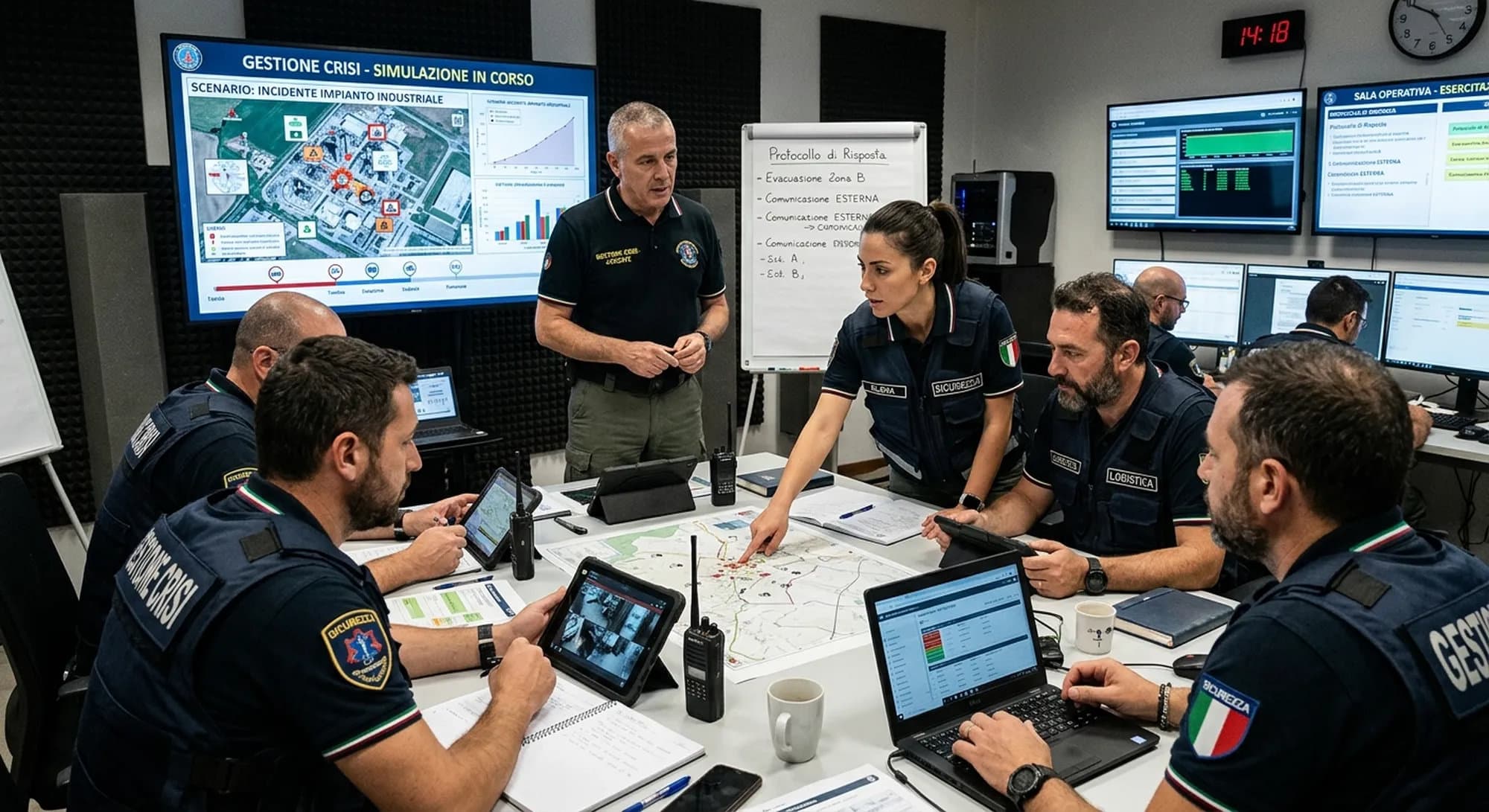
In the contemporary socio‑economic and geopolitical scenario, complex organisations are exposed to asymmetric risk vectors capable of triggering sudden systemic crises. The Crisis Management course delivered by Arcadia Company provides C‑Level executives, Security Managers, Risk Officers and Board members with the analytical, procedural and decision‑making tools needed to govern events of low probability but extremely high reputational, economic or operational impact. The training programme translates the scientific methodologies of strategic planning and business continuity into a structured, governable process for critical events from a legal and corporate perspective.
The teaching modules and advanced simulation sessions are developed in strict compliance with the international guidelines ISO 31000 (Risk Management) and ISO 22301 (Business Continuity Management Systems). The programme operates in full respect of the governance safeguards provided by D.Lgs. 231/2001 and the regulatory framework on occupational health and safety, guaranteeing corporate management professional qualification elements certified ISO 9001:2015. The agency's authorisations and certifications are documented in full.
Architecture of crisis governance and teaching modules
The training pathway is structured to transfer integrated managerial competencies, combining pre‑event predictive analysis with operational containment techniques and post‑event institutional communication:
| Strategic phase | Technical contents and reference standards | Functional outputs for the organization |
|---|---|---|
| Pre‑event planning | Execution of Business Impact Analysis (BIA), establishment of the Crisis Management Team (CMT), drafting of dynamic contingency plans. | Definition of the command chain (Command & Control) and hierarchical escalation protocols. |
| Containment and response | Application of decision‑making models under informational asymmetry, incident classification, flexible resource allocation. | Timely stabilization of core processes and mitigation of material and biological damage to personnel. |
| Media Relations & Recovery | Planning of crisis communication for stakeholders, shareholders and press organs. Post‑mortem debriefing and process review. | Safeguarding brand value, preventing informational speculation, capitalising on experience (lessons learned). |
Predictive analysis, business impact analysis and CMT structuring
Effective crisis management is based on preventive and predictive mitigation activities carried out under normal conditions. The course instructs participants on implementing the Business Impact Analysis (BIA), the analytical process aimed at determining the operational and financial effects resulting from the interruption of critical business functions. Based on the BIA results, dynamic contingency plans are developed, designed to overcome the rigidity of static manuals and to adapt in real time to the evolving threat scenario.
A central module of the training pathway concerns the establishment, training and coordination of the Crisis Management Team (CMT). This inter‑functional governance structure brings together the organisation’s senior figures, including the Security Manager, Legal Counsel, human‑resources heads, IT/CISO directors and senior management members. Through stress tests and classroom simulations, the CMT is trained to optimise the command chain, standardise priority communication flows and reduce reaction latency, preventing decision‑making paralysis.
Intervention protocols and decision models under asymmetry
At the onset of a critical extraordinary event - such as massive data breaches, cyber‑physical attacks on infrastructure, industrial accidents, kidnappings in hostile geopolitical areas or supply‑chain violations - the CMT must activate sequential containment protocols. The primary objective is to isolate the source of instability to prevent systemic propagation. Arcadia Company’s training doctrine places the utmost priority on safeguarding human life and protecting personnel safety, subordinating the stabilisation of material and informational assets to this factor. This often overlaps with our Close protection and event management.
Managers acquire mastery of rapid decision models structured for contexts characterised by high fragmentation and contradictory information. The course trains the ability to extract objective data from informational noise, applying the principle of timely effectiveness: in a crisis situation, adopting a swift and flexible containment strategy is statistically superior to the delayed pursuit of a perfect solution. Allocation and reallocation criteria for economic, technical and logistical resources in fluctuating scenarios are analysed.
Crisis communication, media relations and reputation protection
In the contemporary information ecosystem, the perceived magnitude of a critical event spreads at a speed exceeding that of the actual facts. Uncontrolled dissemination of news through digital channels can cause reputational damage greater than that caused by the original incident. The Crisis Management course devotes an extensive technical‑practical section to Crisis Communication strategies, providing managers with the skills needed to engage with internal and external stakeholders (shareholders, institutions, press, clients and public opinion).
The roles and flows of the Corporate Spokesperson and emergency press office are codified, applying the principles of controlled transparency, technical authority and timely release of official statements. Learners acquire how to strategically occupy the informational void to inhibit the proliferation of speculation or unverified news, maintaining narrative control and preserving collective confidence in the organisation’s command chain, an essential factor to avoid systemic collapse of commercial relationships.
Recovery phase, post‑mortem debriefing and lessons learned
Following the stabilization and resolution phase, governance must coordinate the transition back to ordinary business activities (Recovery Phase). The training process concludes with the methodological analysis of the Post‑Mortem Debriefing. This inspection tool is aimed at chronologically reviewing decisions taken, identifying any procedural bottlenecks and validating countermeasures that yielded positive outcomes.
Excluding punitive logic or the pursuit of individual liability, the debriefing is treated as a Preventive Intelligence asset. Field‑collected evidence enables immediate updating of Business Continuity plans and adjustment of personnel training programmes, raising the overall corporate resilience index in the face of future threats.
Final certification and management requirements
Upon completion of the instructional hours and successful passing of the assessment tests and directional simulation Wargames, Arcadia Company issues the Certificate of Advanced Training in Crisis Management and Organizational Resilience. The title certifies the acquisition of advanced specialist skills, qualifying the participant’s profile in accordance with the requirements for exercising the function of Security Manager (UNI 10459) and Risk Manager.
The course is aimed at executives, managers, legal consultants and corporate security heads. To request the detailed module programme or to design a customised simulation plan to be conducted directly at your organisation’s premises, you may contact the Corporate division of the Academy. A related line of work is Courses.
Cases closed since 2017
of uninterrupted activity
Operational cities in Italy
Zero confidentiality breaches
Do you have a question?
The first consultation is always free and without obligation. We reply within 24 hours.