
Operational personal defence course in Milan.
Advanced course in operational personal defence: neurobiology of conflict, hybrid systems, weapon retention and legal framework under arts. 52-54 c.p. ISO 9001:2015 standard. Since 2017.
The aggressor Content.
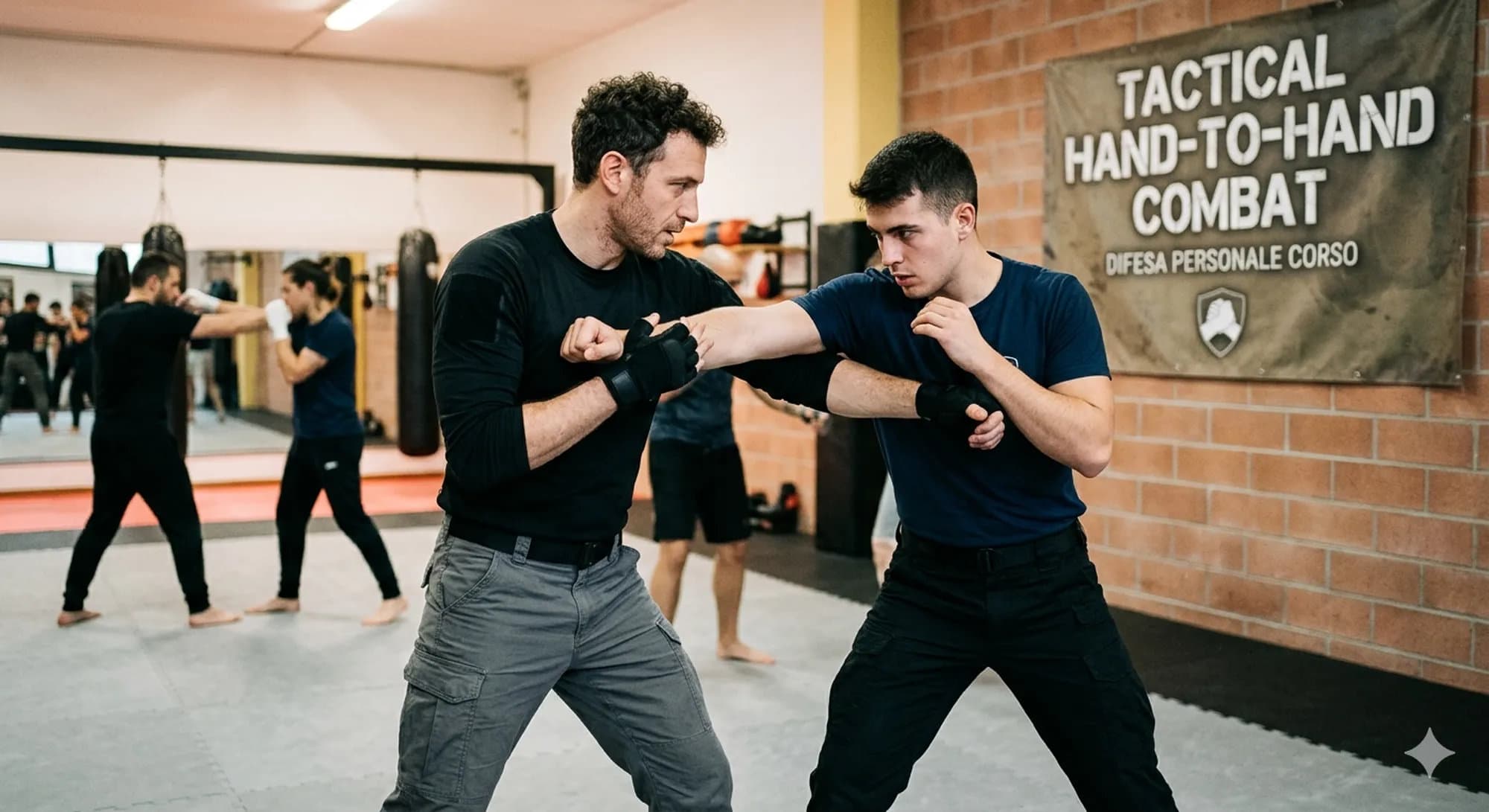
Within the scope of corporate security, personal risk management and accompaniment and close‑protection functions, self‑defence is clearly distinct from competitive sports and martial disciplines. The advanced training program delivered by Arcadia Company is built on strict protocols of biomechanical engineering, conflict psychology and applied criminal law. The primary objective of the course is to impart to participants the technical skills required to intercept, neutralise and contain a physical threat as quickly as possible, minimising collateral damage and ensuring absolute legal compliance of the intervention. A related line of work is Close protection and event management.
Training and theoretical activities are delivered in compliance with the quality‑management requirements certified ISO 9001:2015. The instructional modules analyse the physiological responses of the human body under kinetic stress and provide immediately effective operational tools, validated by international practice and structured to meet the judicial requirements of force proportionality established by Italian law. Our authorisations and certifications set out the framework we operate within.
Structure of the training programme and operational competencies
The instructional pathway alternates psychophysical conditioning sessions under stress with technical modules dedicated to joint levers, disarming and post‑conflict stabilisation procedures:
| Educational module | Technical topics and methodologies | Safety and compliance objectives |
|---|---|---|
| Neurobiology of conflict | Study of the OODA loop, situational awareness and gross motor skills under adrenaline effect. | Reduction of innate reaction times and elimination of errors arising from cognitive shock. |
| Hybrid systems and biomechanics | Tactical integration of Krav Maga‑derived and Jiu‑Jitsu techniques; Weapon Retention techniques and disengagement from bladed weapons. | Maintenance of individual security equipment and control of opponent’s offensive vectors. |
| Legal framework and post‑conflict | Analysis of articles 52 and 54 c.p., ordered immobilisation techniques, handcuffing and tactical first aid. | Legal legitimacy of the containment action and evidentiary admissibility of the conduct. |
Neurobiology of conflict and applied OODA loop
The basis of self‑defence in operational contexts lies in the efficiency of the neurological response before the effectiveness of muscular force. Participants are trained to apply the OODA loop (Observe, Orient, Decide, Act), a cognitive‑processing model developed in a military context to deconstruct the dynamics of temporal confrontation. The course teaches scanning the surrounding environment to raise situational awareness, decoding micro‑signals of body language that precede a physical aggression, in order to interrupt the opponent’s decision chain through a rapid, geometric pre‑emptive action.
Under severe adrenaline spikes, the body experiences a drastic reduction in fine motor skills in favour of gross motor skills. For this reason, Arcadia Company’s training doctrine excludes complex or choreographed movements, focusing exclusively on linear vectors, immediate joint levers and direct strikes on vulnerable nerve centres or anatomical structures less protected by muscle mass. Through targeted repetitions in a controlled environment, the course converts the instinctive defence response into a structured conditioned reflex, reducing latency of execution.
Integrated hybrid systems, Weapon Retention and disarming
The taught techniques combine the best results of international hybrid systems (military Krav Maga, Systema and tactical Jiu‑Jitsu), based on movement economy and the principle of defensive‑offensive simultaneity. Every blocking or deflection action is designed to simultaneously create a biomechanical imbalance in the aggressor, nullifying any advantage arising from a disparity in weight or stature.
A module of fundamental importance for armed operators (armed guards, law‑enforcement, subsidiary security personnel) is dedicated to Weapon Retention. Physical protocols are transferred to prevent the removal of issued equipment (holster, firearm, expandable baton or other coercive tools) both in confined environments and in face‑to‑face situations. Risk‑management protocols for threats involving bladed or cutting weapons are also examined; given the high lethality of the vector, training focuses on offensive‑trajectory deviation lines, instantaneous control of the armed arm and subsequent immobilisation of the subject on the ground.
Post‑conflict management and analysis of the criminal legal framework
The self‑defence action does not end with the interruption of the threat, but continues into the delicate phases of tactical transition and area stabilisation. Trainees acquire mastery of security‑securing procedures, physical restraint (professional handcuffing techniques compliant with operational standards) and security searches, as well as the basics of tactical first aid for arresting massive bleeding caused by penetrating trauma.
Criminal liability associated with the use of physical force is placed at the centre of the theoretical teaching. Through detailed study of sector jurisprudence, the course examines the constitutive limits of the institution of legitimate defence (Art. 52 c.p.) and of state of necessity (Art. 54 c.p.), with particular regard to the following parameters:
- Current danger: Reactive action is legitimate only in the face of an imminent or ongoing threat, excluding retaliatory or delayed conduct.
- Inevitability of damage: Demonstration of the absence of less impactful alternative solutions (e.g., strategic withdrawal or verbal disengagement).
- Proportionality between defence and offence: Comparative assessment between the threatened legal interest (physical safety, life) and the level of force applied for neutralisation.
The module also includes analysis of the defensive use of everyday tools or improvised weapons (e.g., tactical pens, high‑intensity stroboscopic tactical flashlights), defining the limits of carriage and the criteria for legitimate use before inspection and judicial authorities.
Admission requirements and issuance of certifications
Upon passing the theoretical tests on the regulatory framework and the full‑contact physical scenario simulations, Arcadia Company issues the Certificate of specialization in operational self‑defence and containment techniques. The credential certifies the technical‑tactical competencies acquired by the operator, providing corporate management with a fundamental evidentiary element regarding the proper training of personnel exposed to professional aggression risks.
Enrollment in the advanced modules requires submission of a medical certificate of fitness for competitive sport or high psychophysical effort, together with verification of honourability requirements and the absence of disqualifying criminal convictions. Companies interested in dedicated corporate training programmes for special units, stewards or cash‑handling operators can arrange the teaching calendars by contacting the institute’s secretariat. For this area see our Courses.
Cases closed since 2017
of uninterrupted activity
Operational cities in Italy
Zero confidentiality breaches
Do you have a question?
The first consultation is always free and without obligation. We reply within 24 hours.