
Close protection and event management course in Milan.
Advanced course for close protection officers and security managers: close protection of the principal, advanced ops, crowd dynamics and inter‑agency coordination. ISO 9001:2015 standard. Since 2017.
The principal protected.
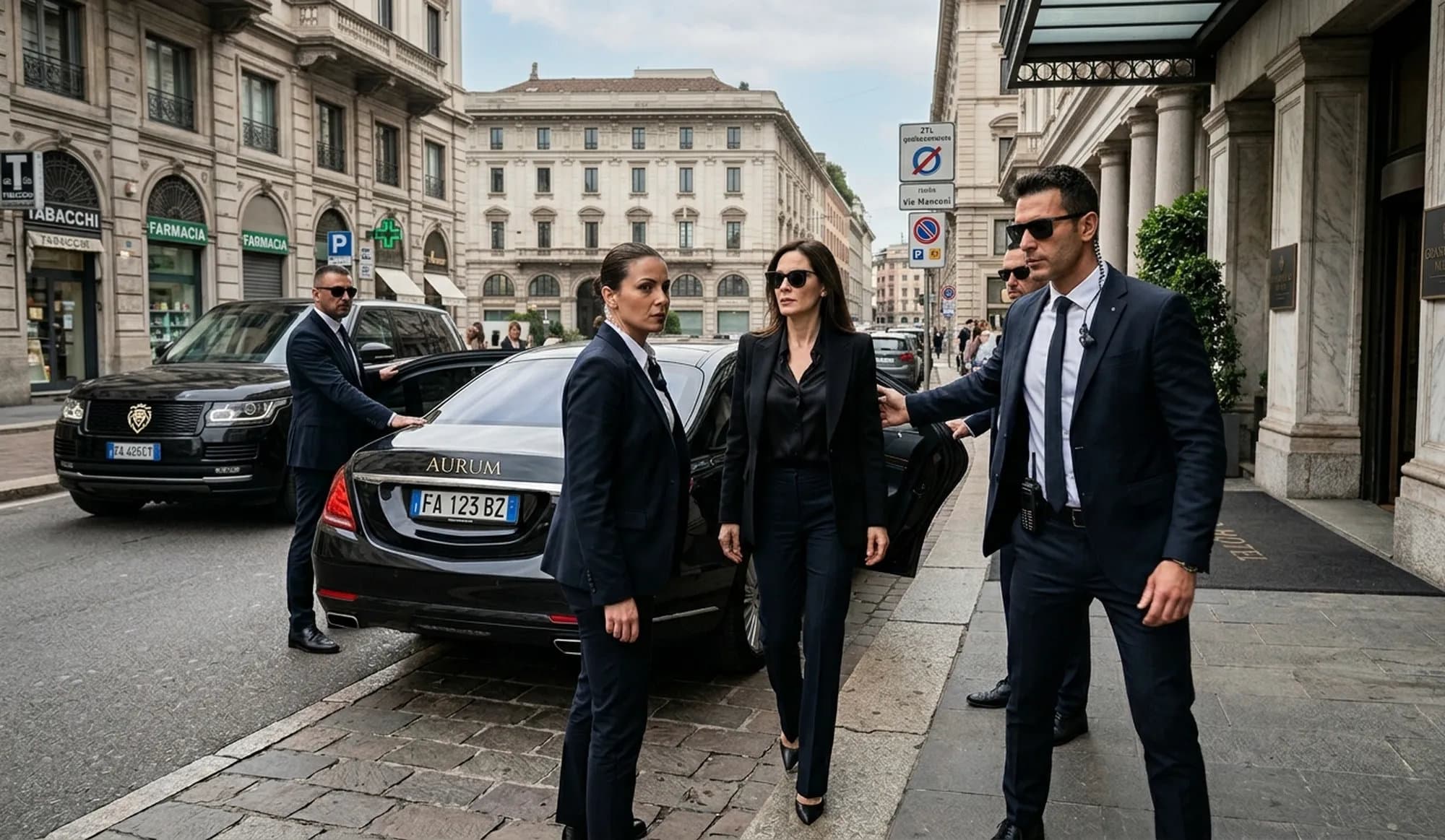
Close protection and security management services for large transactional, corporate or institutional events constitute an integrated operational ecosystem that requires high‑level logistical, legal and psychobehavioural expertise. The advanced course delivered by Arcadia Company is designed to train Close Protection Officers (CPO) and Security Managers capable of building a preventive and predictive security architecture. The core objective of the training is not kinetic reaction to a harmful event, but the design of a controlled environment that eliminates the vulnerability of the protected individual and the operational site.
The curriculum is developed in accordance with best international practices and the Italian regulatory framework governed by the Testo Unico delle Leggi di Pubblica Sicurezza (TULPS) and D.M. 269/2010. Training methods are organized into sequential modules aimed at qualifying operators who can work both in high‑profile private corporate settings and in subsidiary synergy with the Police forces in institutional contexts, ensuring operational standards certified ISO 9001:2015. See our authorisations and certifications for the credentials behind this work.
Functional architecture of the course and specialization modules
The training pathway breaks down protection and flow‑governance methodologies into three macro‑functional areas, interconnected tactically but differentiated by relational context:
| Operational scope | Technical protocols and doctrinal activities | Strategic purpose and output |
|---|---|---|
| Close Protection (accompaniment) | Individualized risk assessment, route planning, advance operations (Advanced Ops), sweeps, dynamic pedestrian formations. | Mitigation of threats to the safety of the Principal and execution of rapid evacuation maneuvers (Cover & Move). |
| Corporate & Private Events | Technical surveillance counter‑measures (TSCM), biometric/technical access control, Crowd Dynamics and modular evacuation plans. | Protection of intellectual property, prevention of industrial espionage and smooth stakeholder management. |
| Institutional security | Inter‑agency coordination, compartmentalization into concentric security rings, management of critical transition points. | Integration into official ceremonial protocols and protection of diplomatic delegations or public officials. |
The architecture of close protection: Advanced Ops and dynamic formations
Protecting an individual with a high exposure index (doctrinally defined as the "Principal") relies on preventive Risk Assessment, an analytical process aimed at mapping and quantifying potential direct or asymmetric threats, including risks to physical safety and reputational harm. The crucial phase of the protocol is represented by Advanced Ops (advance operations): the assigned team conducts reconnaissance and systematic sweeps of every site on the Principal's itinerary, analysing floor plans, egress points, video‑surveillance systems and emergency medical logistics, pre‑plotting rapid routing to hospital facilities equipped with intensive care or resuscitation units.
During pedestrian or vehicular movement, the accompaniment unit adopts dynamic geometric formations that continuously reconfigure according to the surrounding environment. In open or low‑density settings, the formation expands its radius to maximize 360‑degree visual and sector coverage; in high‑density crowds, the unit tightens around the vulnerable individual to form a physical and kinetic filter. Internal team communications are governed by non‑verbal protocols and bone‑conducted encrypted radio devices. When a threat is activated, doctrine mandates the strict principle of Cover & Move: neutralizing the hostility is subordinate to and functional for the immediate evacuation and isolation of the Principal to a predetermined Safe Area.
Corporate security management: counter‑surveillance and Crowd Dynamics
In high‑profile corporate and conference events, security actions must integrate with diplomatic, confidentiality and corporate ceremonial requirements. The CPO must be able to operate in a "low profile" mode, reducing the visual impact of their presence and blending with the event’s relational context without lowering situational alert levels. In this scenario, physical protection merges with information security; the curriculum includes training on TSCM (Technical Surveillance Counter‑Measures) activities aimed at electronic sweeps of conference rooms or meeting halls to detect and neutralize bugs, laser interception vectors or illicit data‑capture devices, mitigating the risk of industrial espionage. This often overlaps with our Personal defence.
Managing the public at elite private events requires the application of behavioural sciences and the study of mass dynamics (Crowd Dynamics). Operators are trained to detect anomalous behavioural indicators before they can cause systemic issues. Guest control and accreditation procedures are carried out using technical filtering and biometric technologies, optimizing flows to prevent bottlenecks or unmanaged gatherings at entry points. The emergency management plan is structured according to modular criteria, providing graduated response thresholds ranging from targeted removal of unauthorized disruptors to fully coordinated site evacuation.
Institutional complexity: concentric security rings and transition points
Protecting institutional figures, government officials or foreign diplomatic delegations requires strict adherence to State protocols and rigorous inter‑agency cooperation. Operational space planning adopts the doctrinal model of concentric security rings. The outer perimeter is tasked with macro‑traffic control and monitoring of vehicle flows; the intermediate perimeter is dedicated to technical and advanced security screening, employing metal‑detector portals, radiogenic baggage inspection systems and anti‑sabotage K9 units; the inner perimeter (the "security bubble") encloses the Principal and is accessible only to personnel with top‑level credentials and the Close Protection team.
In this context, every macro‑movement is rigidly codified in line with ceremonial dictates: the deployment order of the motor convoy, embarkation and disembarkation procedures, and the geometric positioning of operators during the protected individual’s public engagements. Training places a selective emphasis on managing transition points - such as the mandatory passages between the cabin of an armored vehicle and the entrance of a building - statically identified as the time windows with the highest strategic vulnerability index. Perfect service fluidity is not left to individual initiatives, but to rigorous planning of synchronized logistical and operational variables.
Regulatory framework, TULPS and professional requirements for access
The practice of Close Protection and subsidiary security activities in Italy is subject to compliance with the current public‑security regulatory framework, particularly article 134 of the TULPS and the provisions of D.M. 269/2010. Arcadia Company’s course provides the essential legal compliance framework to operate within authorized private security firms or corporate security divisions, analysing the limits of intervention powers and the mandatory cooperation with the Public Security Authority in line with guidelines issued by the Department of Public Security.
Access to the specialization course requires stringent prerequisites, including legal age, no criminal record or disqualifying pending charges, psychophysical fitness certified by public health facilities, and preferably prior experience in the armed forces, law‑enforcement agencies or regulated private security. Upon passing theoretical exams and field tactical assessment, a Certificate of Specialization in Close Protection and Crowd Management is issued, valid for the professional qualification of employee personnel.
Contacts and corporate fleet programming
Companies, multinational security offices, investigative agencies and authorized security firms can request the development of customized training modules, tailored to the specific mobility needs of their management or the risk matrices of their international assets. For information on training calendars, fees and enrollment requirements, you can contact the programming office of Arcadia Academy. A related line of work is How much does a private investigator cost.
Cases closed since 2017
of uninterrupted activity
Operational cities in Italy
Zero confidentiality breaches
Do you have a question?
The first consultation is always free and without obligation. We reply within 24 hours.